

- Your cart is empty
- Continue Shopping
Icebreakers in the Classroom: Building Connections Before Learning Begins
Every Great Lesson Begins with a Connection
Imagine walking into a room full of strangers. Before meaningful conversations begin, people naturally look for a sense of comfort, belonging, and familiarity.
Students experience the same feeling every day—at the beginning of a new academic year, when joining a new class, after vacations, during workshops, or even before starting a challenging lesson.
This is where icebreakers become invaluable.
Contrary to popular belief, icebreakers are not merely fun games or time-fillers. They are carefully designed learning experiences that help build relationships, establish psychological safety, encourage participation, and prepare students for meaningful learning.
Research consistently shows that students learn better when they feel connected to their peers, trust their teacher, and experience a positive classroom environment.
What Are Icebreakers?
Icebreakers are short, structured activities designed to help learners:
- Get to know one another
- Build trust and confidence
- Reduce anxiety
- Encourage communication
- Create a positive classroom climate
- Foster collaboration/ team work
- Prepare students mentally for learning
They can be used in physical classrooms, online learning environments, workshops, teacher training programmes, and professional development sessions.
Why Are Icebreakers Important?
1. They Reduce Anxiety
The first few minutes of any class often determine how comfortable learners feel.
Icebreakers lower stress levels by creating a welcoming environment where students feel accepted.
2. They Build Relationships
Students who know each other are more willing to:
- Collaborate
- Ask questions
- Share ideas
- Respect different perspectives
Strong relationships lead to stronger learning communities.
3. They Increase Student Engagement
When learners actively participate from the very beginning, they are more likely to remain engaged throughout the lesson.
Participation creates ownership.
4. They Promote Communication Skills
Many activities encourage learners to:
- Listen actively
- Speak confidently
- Ask thoughtful questions
- Express themselves respectfully
These are essential life skills that extend beyond the classroom.
5. They Build Classroom Culture
A positive classroom culture is not created through rules alone.
It develops through repeated experiences where students feel heard, valued, and included.
Icebreakers help establish this culture from Day One.
When Should Teachers Use Icebreakers?
Icebreakers are useful throughout the academic year, not only during the first week of school.
Consider using them:
- On the first day of school
- After long vacations
- Before starting a new unit
- When introducing group projects
- Before parent workshops
- During online classes
- In teacher training sessions
- During orientation programmes
- Before difficult or emotionally demanding discussions
Characteristics of an Effective Icebreaker
An effective icebreaker should be:
- Inclusive
- Age-appropriate
- Purposeful
- Simple to explain
- Time-efficient
- Safe and respectful
- Interactive
- Connected to the learning objective whenever possible
The goal is not entertainment—it is connection.
Icebreaker Ideas Across Different Age Groups
Early Years (Ages 3–6)
Young children learn through movement, music, stories, and play.
Examples
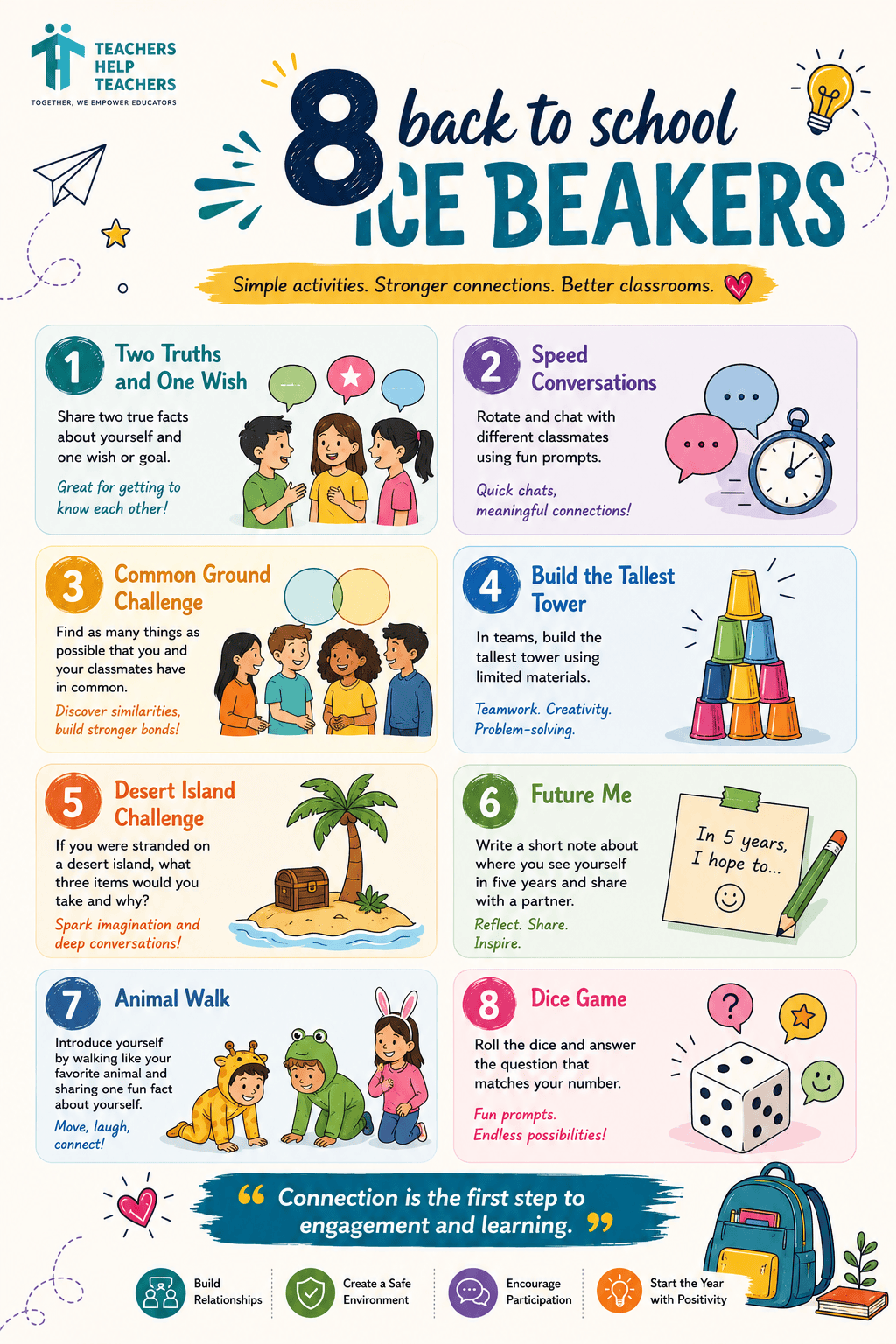
1. Name & Action
Each child says their name with a movement. The class repeats both.
Purpose: Builds confidence and memory.
2. Feelings Circle
Children point to or choose an emotion card and explain how they feel today.
Purpose: Develops emotional vocabulary and self-awareness.
3. Find Something…
“Find something red.”
“Find something soft.”
“Find something round.”
Purpose: Observation, movement, and language development.
4. Animal Walk
Children move like different animals while introducing themselves.
Purpose: Physical engagement and imagination.
Primary Years (Ages 6–11)
Primary learners enjoy creativity, teamwork, and exploration.
Examples
1. Two Truths and One Wish
Students share two true facts and one goal or wish.
Purpose: Helps classmates discover common interests.
2. Classroom Bingo
Students find classmates who:
- Have a pet
- Like reading
- Can ride a bicycle
- Speak another language
Purpose: Encourages interaction with many classmates.
3. Would You Rather…?
Example:
Would you rather explore space or the ocean?
Students explain their choices.
Purpose: Encourages speaking and reasoning.
4. Build the Tallest Tower
Using paper or straws, teams build the tallest tower.
Purpose: Collaboration and problem-solving.
Middle Years (Ages 11–14)
Adolescents value identity, belonging, and peer relationships.
Activities should encourage meaningful conversation without putting students under unnecessary pressure.
Examples
1. Common Ground Challenge
Groups discover ten things they all have in common.
Purpose: Builds empathy and teamwork.
2. Speed Conversations
Students rotate every two minutes and answer discussion prompts.
Examples:
- A skill I would love to learn
- A book everyone should read
- My biggest inspiration
Purpose: Communication and confidence.
3. Desert Island Challenge
Students choose three items they would take to a deserted island and explain why.
Purpose: Critical thinking and discussion.
4. Emoji Introduction
Students introduce themselves using only five emojis before explaining their choices.
Purpose: Creativity and self-expression.
High School (Ages 14–18)
Older learners appreciate authenticity, reflection, and activities with real-world relevance.
Examples
1. Personal Timeline
Students share three moments that shaped who they are.
Purpose: Reflection and relationship building.
2. Human Spectrum
Students stand along a line representing their opinions on statements.
Examples:
“I enjoy public speaking.”
“I prefer working independently.”
“I like taking risks.”
Students discuss their choices respectfully.
Purpose: Perspective-taking and respectful dialogue.
3. Problem-Solving Challenge
Small groups solve a real-world problem within ten minutes.
Purpose: Collaboration and leadership.
4. Future Me
Students write a short note describing where they hope to be in five years and discuss their aspirations in pairs.
Purpose: Goal setting and meaningful conversation.
Tips for Teachers
Remember that the objective is not to complete an activity—it is to create a learning environment where every student feels seen, heard, and valued.
As you plan your icebreakers:
- Keep instructions simple.
- Encourage participation without forcing it.
- Celebrate every contribution.
- Avoid activities that may embarrass learners.
- Adapt activities to cultural and classroom contexts.
- Always connect the activity to the day’s learning where appropriate.
Small moments of connection often lead to the biggest learning outcomes.
Final Thoughts
Learning begins with relationships.
Before students can confidently answer questions, collaborate in groups, or take intellectual risks, they need to feel that they belong.
A thoughtfully planned icebreaker can transform a classroom from a room full of individuals into a genuine learning community.
Whether you teach curious preschoolers, energetic primary learners, thoughtful adolescents, or aspiring young adults, investing just five to ten minutes in meaningful connection can have a lasting impact on engagement, confidence, and academic success.
At TeachersHelpTeachers (THT), we believe that great teaching starts with strong relationships—and sometimes, all it takes is the right icebreaker to spark those connections.