

- Your cart is empty
- Continue Shopping
Forgot “What You Learned?”: Try This Exit Ticket Instead
- Posted on
-
 Posted by:
admin
Posted by:
admin - 0 comments
- Categories: blog
How Hexagonal Thinking Can Elevate Classrooms
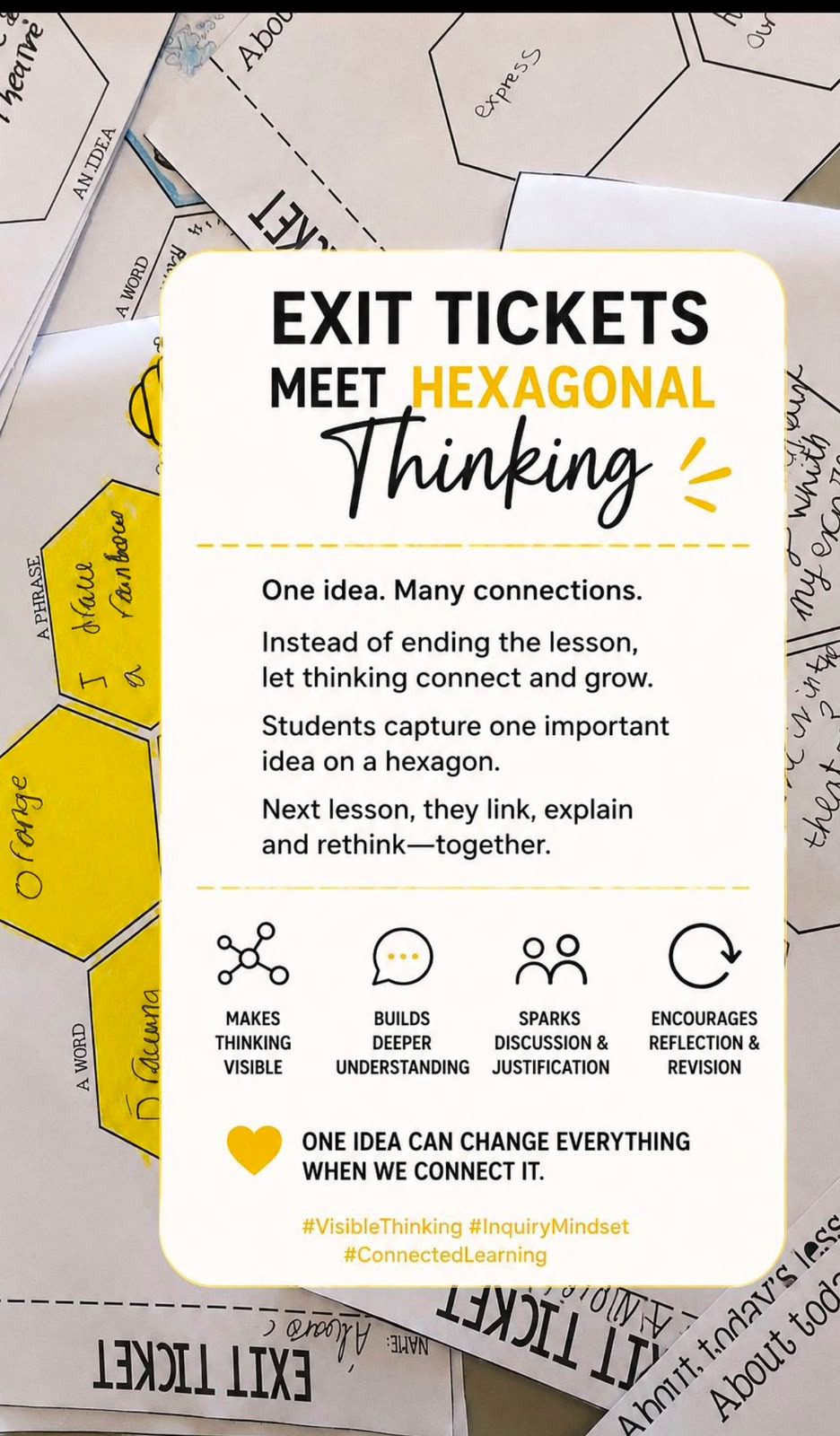
What if your exit ticket could tell you not only what students remember, but how they connect ideas?
At the end of a lesson, it is easy to ask, “What did you learn today?” and collect a few predictable answers. But students can often recall a definition without being able to explain how ideas relate to one another. Hexagonal Thinking offers a simple way to change that. Instead of asking students to reproduce information, give them key terms on hexagons and ask them to connect, explain, and justify their choices. The result is an engaging exit ticket activity that makes student thinking visible.
How to Use Hexagonal Thinking as an Exit Ticket
1. Give students hexagons with important terms or concepts.
2. Ask them to arrange the terms based on meaningful connections.
3. Add arrows to show the relationships they want to explain.
4. Ask students to provide a clear explanation for their chosen connections.
The activity can also be used as a do-now, homework activity, alternative assessment, or an evolving concept web throughout a unit.
Make It Work for Every Learner
Hexagonal Thinking can be differentiated without changing its core purpose. Teachers can:
• Reduce the number of hexagons
• Provide a word bank
• Partially complete the web
• Add guiding arrows
• Provide sentence starters
• Encourage collaborative work
• Use pictures instead of words for emerging readers, writers, and multilingual learners
Note: As students become more confident, gradually reduce the scaffolding.
Ready to Try It?
Bring Hexagonal Thinking into your next lesson and turn a simple exit ticket into an opportunity for connection, discussion, justification, and reflection. And if you’re looking for more practical classroom strategies, creative teaching ideas, and resources that help make student thinking visible, explore Teachers Help Teachers (THT) and discover more ways to make learning meaningful!
Liked what you read? Find more helpful content and stay updated at –
https://www.instagram.com/teachershelpteachersindia
https://www.youtube.com/c/teachershelpteachers/about
classroom thinking strategies, exit ticket activities for teachers, Hexagonal Thinking strategy, visible thinking strategies